
Solution Guide
Launch a lean Etsy print-on-demand shop
Launch an Etsy print-on-demand operation with a narrow product family, a validated supplier, controlled listings and enough cash for fulfillment.
Read article →
Calculate contribution per POD order after production, shipping and variable fees. Use it to test retail prices and subscription decisions without confusing sales with profit.
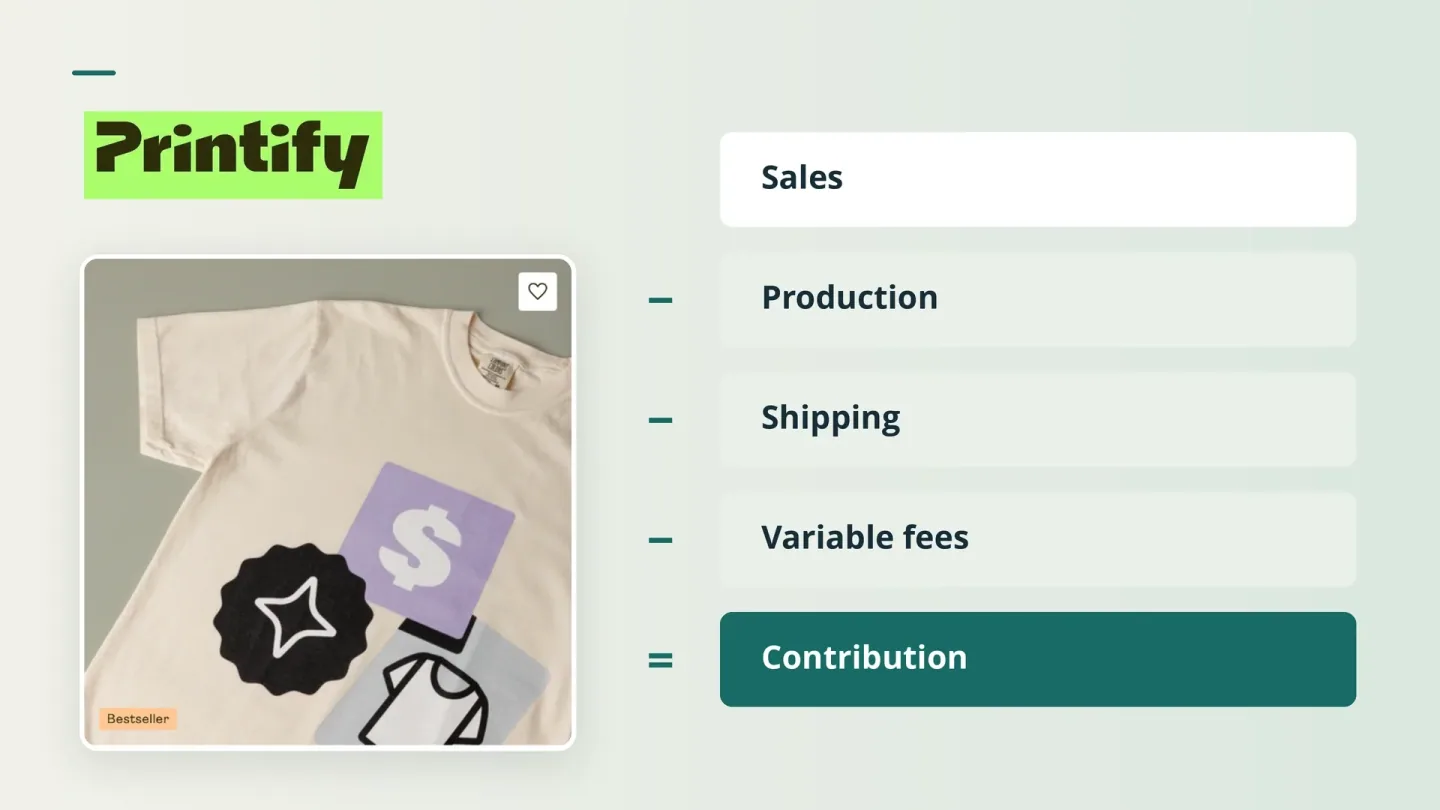
Before I raise the ad budget or run a discount, I’d calculate what one normal order leaves after variable costs. That amount still has to cover fixed bills before it becomes profit. If the order loses money before those bills, I’d change its price, delivery cost or offer before trying to sell more of it.
Net sales revenue here means the product and shipping revenue you keep after discounts or refunds, excluding tax collected for remittance where applicable. Subtract the product and print cost, supplier shipping, payment and marketplace fees, and any other variable cost attributable to that order. Do not subtract collected tax as if it were a normal product cost after already excluding it from revenue.
Take a hypothetical US-dollar order with a $25 shirt and $5 shipping charged to the buyer, for $30 revenue before applicable fees. Assume $12 production, $5 supplier shipping, a 6.5% Etsy transaction fee ($1.95), a $0.20 listing allocation, $1.20 assumed processing and $1 assumed other variable cost. Total variable costs are $21.35 and the contribution is $8.65, or about 28.8% of revenue. The 6.5% and listing fee are Etsy’s published reference figures, while the other inputs are examples rather than provider or payment quotes. Etsy’s processing rate depends on the seller’s country. Taxes, advertising, refunds and regulatory fees can change the outcome.
Free shipping is a pricing presentation, not free fulfillment. If you remove the buyer’s $5 shipping charge without changing the item price, revenue falls to $25 and percentage-based fees also change. Recalculate the complete order rather than simply deleting shipping from cost.
Production + shipping: $17; Transaction + listing: $2.15; Processing + other: $2.2; Contribution: $8.65
Contribution per order updates with Shirt retail price (USD). Exact value is below the graphic.
At 50 identical orders, $8.65 each would contribute $432.50 before fixed expenses. If software subscriptions and other fixed costs total an assumed $100 that month, the modeled operating result is $332.50 before owner labor, income tax and other excluded costs. If the order mix includes lower-margin products, the actual result differs.
Returns require careful treatment. A refund reduces revenue; any unrecovered fulfillment, payment or return costs still affect the order. Do not subtract a refund again if revenue has already been adjusted. Advertising directly attributable to an order can be treated as variable cost, while an unallocated fixed campaign budget should be modeled separately. Etsy Offsite Ads and other country-specific fees must be included when applicable.

Contribution: $432.5; Fixed expenses: $100; Modeled result: $332.5
A paid fulfillment plan changes the contribution only by the savings that actually apply to the variants you sell. Compare the same SKU, provider, destination and quantity on the free and paid plan. If a $39 monthly fee saves an assumed $2 per fulfilled unit, 20 eligible units are needed to cover it; 19 save $38, still short of the fee. At 50 eligible units the gross saving is $100 and the net subscription saving is $61 before other changes.
If the actual average saving is zero, no volume recovers the fee through product discounts alone. If there is more than one unit in an order, count units rather than orders. An annual commitment changes the cash timing and the measurement horizon. The Premium pricing article handles that comparison separately.
Record product revenue, buyer shipping, discounts, refunds, production, supplier shipping, marketplace fees, processing and other variable costs for each SKU or order. Use statements from the selling channel and supplier rather than estimated dashboard revenue alone. Reconcile unusual orders instead of assuming the average covers them.
When changing a price, recalculate low, typical and high-cost variants. Check what happens if a buyer orders two products to a different destination or if a replacement must be paid for. A product with positive typical contribution but repeated loss-making variants needs a pricing or fulfillment correction. I would fix that before adding more designs.
REVENUE: Product + retained shipping − refunds; VARIABLE COSTS: Production, shipment, fees, extras; CONTRIBUTION: Compare variants and actual receipts
Include retained shipping revenue and subtract the actual supplier shipping expense.
No. Fixed overhead, owner labor, tax and other excluded costs remain.
Use a sales-weighted average or calculate the variants separately; do not apply the maximum advertised discount to all units.
Vendor documentation and SellerPlanKit product evidence dated November 26–27, 2026. Prices are reference amounts, not account-specific quotes. Examples are explicitly illustrative. No new paid-account testing, performance benchmark or numeric rating is claimed.
Launch an Etsy print-on-demand operation with a narrow product family, a validated supplier, controlled listings and enough cash for fulfillment.
Read article →
The 2024 Printful–Printify merger led to the FYUL parent organization. What sellers can verify about the combined group, separate platforms and the operational decisions that still matter in 2026.
Read article →
Five tools for five distinct seller bottlenecks: website building, fulfillment, creator commerce, Shopify page design and Squarespace customization.
Read article →