Shopify is a hosted commerce platform for selling through a branded store, connected sales channels and retail operations. Its strongest case is a business that needs a reliable order-management workflow and expects its catalog or team to grow; payment eligibility and recurring app costs can change the economics.
★★★★★★★★★★4.3/5Editorial rating
Website BuildersCore Platform
Our verdict
★★★★★★★★★★4.3/5Editorial rating
For a shop that expects orders, inventory and multiple sales channels to become daily work, Shopify Basic is where I’d start. I’d run one order from payment to refund and price any essential apps before paying annually. I’d look for a smaller checkout solution if the existing website already does the rest of the job.
Why this rating?
The documented operating workflow is broad. App costs, payment eligibility and the work of moving a configured store keep it below a perfect score.
Research & assessment details
Documentation-based assessment by SellerPlanKit Editorial. No hands-on benchmark.
I would judge Shopify by the work it removes after the first sale. Build one product with real variants, configure shipping, take an eligible test payment and verify order routing. For a print-on-demand shop, check the supplier charge, tracking update and refund workflow before paying for a premium theme. Shopify lists Printify, Printful and Gelato in its app marketplace, but the supplier remains responsible for its own fulfillment terms.
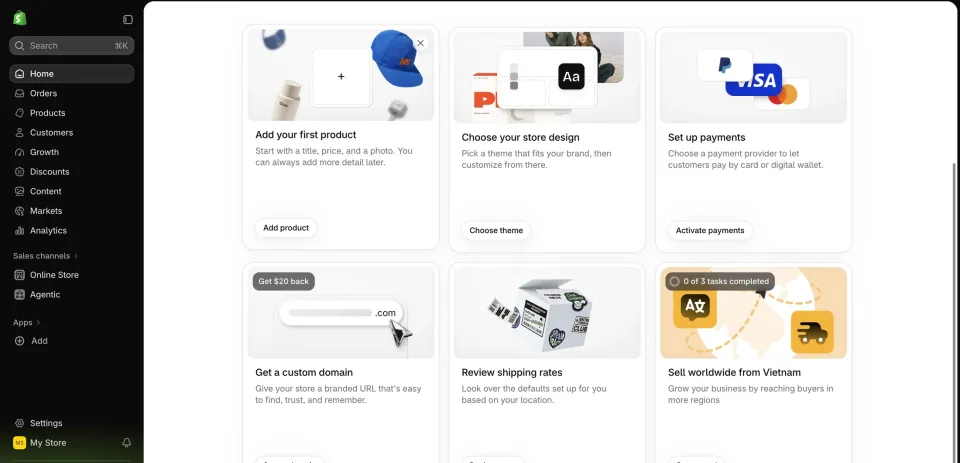
The checklist gives a practical order for setting up the store before running a test checkout.
Choose the subscription around the bottleneck
Basic includes a full store and is the sensible starting point for an owner-operated catalog. Grow adds five staff accounts; Advanced adds fifteen and additional market capabilities. Plus is a contract-led purchase for needs such as deeper checkout changes or company-specific wholesale catalogs. Starter is a simpler social-selling option, not the full storefront. Retail and Agentic are separate channel-focused offerings; Agentic has no full online store.
Pick a subscription around the selling channels you expect to operate first.
Calculate the fee before upgrading
Compare subscription plus the payment processor, platform transaction charges, apps and fulfillment. The published reference third-party fees are 2%, 1% and 0.6% for Basic, Grow and Advanced respectively. If monthly subscriptions are $39 and $105, saving one percentage point on eligible fee-bearing sales offsets the $66 gap at $6,600 per month. This calculation excludes card-rate differences and app costs. Check your actual local payment rates, not just the advertised US table.
Catalog, checkout and wholesale limits
Shopify supports up to 2,048 variants and three native option axes per product; apps or line-item inputs handle additional customization. Digital delivery and subscriptions use apps. Standard checkout branding is available on Basic and higher, while apps that alter information, shipping or payment steps are Plus-only. Standard full-store plans now have limited B2B catalogs; Plus adds direct company-location assignment and advanced payment terms.
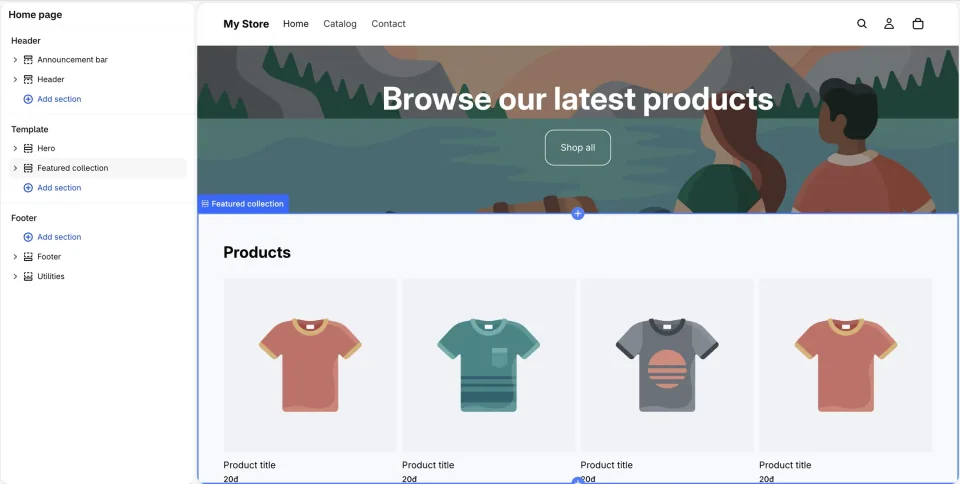
The theme editor shows how the catalog is presented. Inventory, checkout and wholesale settings need their own checks.
International operations and ownership
Markets can help organize international sales, but currency, duties, tax and payment availability depend on the account and location. For a physical store, POS Pro adds a separate per-location cost. Keep independent product, customer and order exports. CSV exports do not preserve a running checkout or app configuration, and product images are not included as binary files. A Hydrogen storefront changes the frontend architecture; it does not remove dependence on the commerce backend.
My buying decision
I would start on Basic if one owner can manage the store, then move to Grow for staff access or a measurable fee saving. Do not budget Plus simply because a brand needs a polished checkout. Price the precise extension, B2B or operational requirement first. If the main requirement is to add a small store to a website you already maintain, compare Ecwid before migrating. This assessment is documentation-led; no fresh checkout, load or conversion test was performed.
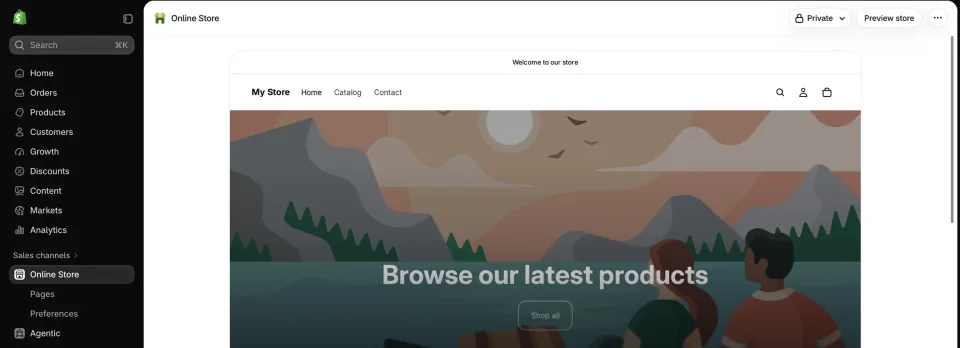
Use a storefront preview to test the path from the homepage to a product before sending it live.
USD regular full-store reference rates from the current indexed vendor table checked November 26, 2026. Another opened vendor table showed lower Basic/Grow prices ($25/$65 monthly, $19/$49 annual equivalents); confirm account and country before paying. Annual amounts are twelve times explicitly advertised yearly-billed monthly equivalents. Plus rates are monthly contract commitments: $2,500 on one year or $2,300 on three years for standard USD setups; complex businesses may pay variable fees. Starter, Retail and Agentic have separate scope; Starter/Retail prices not verified here, and free Agentic cannot publish a full store. POS Pro, card processing, apps, taxes and fulfillment are separate. No promotional prices used.
Listed prices may exclude taxes. Promotions and vendor terms can change; confirm at checkout.
When does the lower transaction fee cover Grow?
Basic monthly platform cost171 USD
Grow monthly platform cost171 USD
Compare the subscription and Shopify third-party fee on eligible monthly sales. Excludes payment processing, credits, taxes and other charges. Enter your actual plan prices and fee-bearing sales; this assumes the reference 2% and 1% fee rates apply.illustrative · Reference monthly subscription amounts and third-party fee percentages from the vendor pricing table; actual account rates vary.Text description
Two bars compare Basic and Grow subscription plus eligible sales times the third-party fee rate; the lower monthly cost appears below.
AT A GLANCE
Key features
01
Full hosted store with inventory and order management
02
Payment-provider and plan-dependent transaction fees
03
2,048 native variants per product and three option axes
04
POD, marketplaces and POS via eligible channels
05
CSV portability; headless frontend option
06
Plan-specific checkout and B2B entitlements
Features & compatibility
Vendor-sourced facts are based on published documentation; exceptions are labelled. Sources and check dates are grouped below each section.
International & marketing4 items
Discount tools
Discount tools and marketing; conditions by plan
International pricing and currency
Markets; payment/provider restrictions
Store analytics
Analytics on all plans; detailed reporting varies
Store localization
Markets; locale capabilities depend on plan and provider
Sources & verification for International & marketing
Covers: Platform fee on third-party payments, Subscription model
THE TRADE-OFFS
Pros & cons
What works well
Commerce administration and channel integrations in one hosted system.
Clear upgrade triggers in staff capacity, checkout customization and wholesale features.
CSV exports and documented developer storefront options.
What to consider
Third-party payment fees and paid app subscriptions can compound.
Native checkout changes are restricted by tier; external frontend does not make checkout portable.
Merchant-country eligibility can determine payment and international workflows.
Best for
Growing branded product stores with regular orders.
POD sellers who need a centralized supplier-app and order workflow.
Teams needing inventory, channel and staff coordination.
Consider alternatives if
Sellers whose payment provider or business category is unsupported.
Small existing websites that only need an embedded checkout.
Businesses requiring full self-hosted ownership of commerce runtime.
BEFORE YOU DECIDE
Frequently asked questions
Does Shopify require its own payment processor?
No. Eligible third-party providers can be used, but Shopify may add a platform transaction fee. Confirm the provider in your merchant country.
Can I run POD without holding stock?
Yes, through supplier apps such as Printify, Printful or Gelato. Supplier costs, product mapping and fulfillment terms are separate from Shopify.
Is Shopify B2B available only on Plus?
No. The reviewed B2B documentation allows up to three active market catalogs on Basic, Grow and Advanced. Plus adds unlimited catalogs, direct location assignment and advanced payment features.
Can I move my Shopify store elsewhere?
Product and customer CSV exports and historical order exports are available. A migration still requires rebuilding checkout, app workflows and theme behavior.
Ecwid is a hosted ecommerce backend that can add a store to an existing website or run a standalone Instant Site. It is especially useful when the website should stay where it is, provided catalog, staff and integration limits fit the business.